
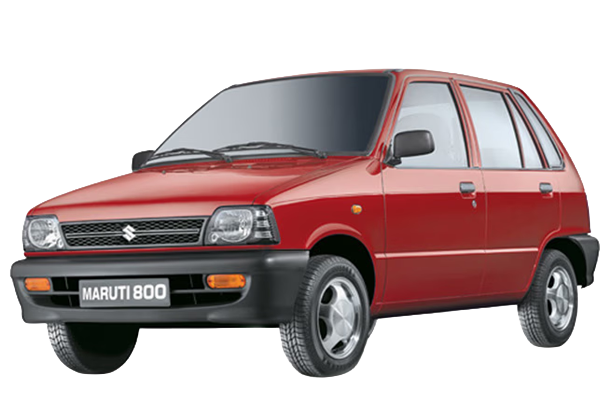


Brand Overview
- India comes home in a Maruti Suzuki
- The car that put India on wheels
- The People's Car
Market Entry and Context
Before the 1980s, India's car market was dominated by two outdated models: Hindustan Ambassador and Premier Padmini. Cars were expensive, unreliable, and seen as a luxury. Long waiting periods, inefficient engines, and limited ownership made car buying an aspiration rather than a reality.
In 1981, the Government of India entered a joint venture with Suzuki Motor Corporation of Japan to modernise the automobile sector. The Maruti 800 became the flagship vehicle of this effort, representing modern engineering and economic accessibility.
Marketing Mix (4Ps)
 Product Strategy
- Compact Hatchback Design: Optimised for India's congested urban roads.
- Fuel Efficient Engine: ~796 cc petrol engine-reliable and cheap to maintain.
- Low Maintenance: Simple engineering, affordable spare parts, and high serviceability.
- Continuous Upgrades: Introduced facelifts, improved mileage, emissions compliance, and later an MPFI engine.
Maruti built the product around accessibility, practicality, and reliability, not luxury.
 Pricing Strategy
Maruti 800's pricing was revolutionary-priced significantly lower than existing models.
- Initial price (1983): Approx ₹47,500
- Government support (tax concessions, localisation) ensured affordability.
- Introduced easy instalment-based finance for the first time, democratising ownership.
The brand made price a strategic lever for mass adoption, positioning the 800 as the "first car of India."
 Promotion Strategy
Marketing focused on:
- Aspirational messaging: Owning a Maruti meant progress.
- Trust and safety: Japanese technology + Indian accessibility.
- "People's Car" positioning: A car for families, not elite buyers.
The 1983 launch became iconic-Indira Gandhi personally handed the keys to the first customer.
 Distribution Strategy
Maruti introduced India's first modern automotive distribution model:
- Nationwide dealership expansion
- Trained customer-facing staff
- Transparent pricing and after-sales support
The service network became a competitive moat.
Challenges and Response
| Challenge | Response |
| Rising competition (Hyundai Santro, Tata Indica) | Upgrades, aggressive pricing, broader product lineup |
| Changing consumer expectations | Shift toward premiumising Maruti (Zen, Alto, WagonR) |
| Regulatory pressure (safety, emissions) | Gradual discontinuation and migration to newer platforms |
Despite demand, the model was discontinued in 2014 as it could not meet modern safety/emission norms without substantial reengineering.
Competitive Landscape
Pre-launch: Minimal competition from Ambassador and Premier.
Post-launch: New entrants like Hyundai, Tata Motors, and Daewoo brought modern technology.
Yet, the Maruti 800 maintained dominance for nearly two decades because of:
- Reputation for reliability
- After-sales excellence
- Strong resale value
Loyalty among middle-class buyers
Related Case Studies
Innovations & Adaptation
Maruti pioneered several industry innovations:
- Factory-fitted AC and variants across budgets
- Fuel injection and BS emission compliance
- First large-scale localisation of spare parts
- Novel financing ecosystem with banks
These innovations enabled volume scaling and sustained leadership.
Consumer Perception & Cultural Connect
For many Indians, owning a Maruti 800 represented:
- Economic progress
- Freedom and mobility
- Reliability and familiarity
It became a national cultural symbol - appearing in movies, ads, and family milestones.
Impact and Legacy
- Created India's car-owning middle class
- Built India's first large-scale automotive supply chain
- Became the highest-selling car in Indian history (over 2.7 million units)
- Catalysed the evolution of India's automobile market
The Maruti 800 did not just sell cars - it transformed urban mobility and auto culture.
Summary
The Maruti 800 remains one of the most iconic products in Indian business history. Its journey from an affordable compact car to a cultural and mobility movement reflects strategic clarity, execution excellence, and deep understanding of a transforming India.
More than a car, the Maruti 800 was a symbol of modernisation, aspiration, and accessibility, shaping India’s automotive future and setting the template for mass-market product success.