
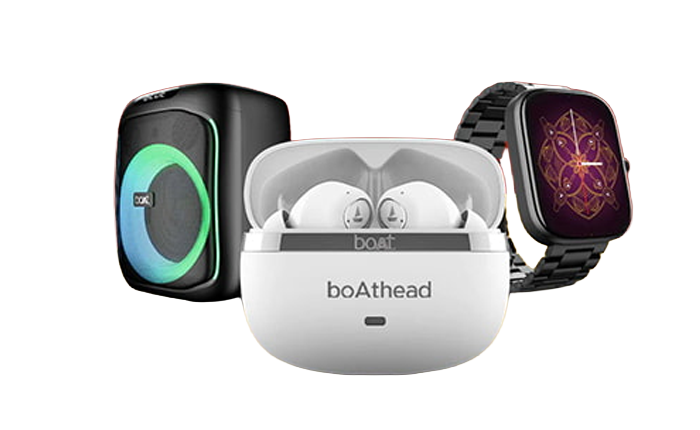


Brand Overview
- Plug into Nirvana
- Do What #FloatsYourboAt
Market Entry and Context
boAt entered the market at a moment when:
- Smartphones were ubiquitous, but accessories were largely commoditised
- Global brands (Sony, JBL, Skullcandy) were premium-priced
- Unbranded/low-quality Chinese imports dominated the mass segment
- Young Indian consumers were becoming style- and brand-conscious
There was a clear gap for a branded, affordable, design-forward audio brand that understood Indian usage and price sensitivity.
Marketing Mix (4Ps)
 Product Strategy
boAt's product strategy centred on:
- Audio-first portfolio (wired earphones → wireless earbuds → wearables)
- Trend-led design, colourways, and naming
- Rapid launch cycles and SKU experimentation
- Feature parity with global brands at lower prices
Key moves:
- Early focus on durability (braided cables, sweat resistance)
- Fast pivot to TWS earbuds during the wireless audio boom
- Expansion into smartwatches as "fashion tech," not health devices
boAt prioritised what young consumers noticed, not lab specs.
 Pricing Strategy
Pricing was boAt's sharpest weapon:
- Mass-premium sweet spot (₹999-₹4,999)
- Frequent promotions without damaging brand perception
- Value perception driven by features + design
boAt avoided ultra-low pricing, positioning itself as aspirational but accessible, enabling high volumes with healthy margins.
 Promotion Strategy
Promotion was deeply youth- and culture-led:
- Aggressive influencer marketing across YouTube, Instagram
- Strong use of meme culture and digital-first storytelling
- Celebrity endorsements (cricketers, Bollywood stars)
- Sponsorship of IPL teams and youth-centric events
The brand voice was playful, irreverent, and pop-culture fluent, unlike traditional electronics brands.
 Distribution Strategy
boAt scaled through an omnichannel but digital-first approach:
- Strong presence on Amazon, Flipkart
- D2C website for launches and brand storytelling
- Gradual offline expansion into electronics retail chains
The brand used online marketplaces for scale and data, not just distribution.
Challenges and Response
| Challenge | Response |
| Commoditisation of wearables | Brand-led differentiation |
| Quality perception | Improved QC and warranty |
| Rising competition | Faster launches, collaborations |
| Margin pressure | Portfolio expansion and scale |
| Brand fatigue risk | Refreshing creatives and ambassadors |
boAt consistently chose speed and relevance over perfection.
Competitive Landscape
boAt competes across multiple layers:
- Global brands: Sony, JBL, Skullcandy (premium)
- Chinese brands: Realme, Redmi (value tech)
- Indian startups: Noise, Fire-Boltt (wearables)
boAt differentiated itself through:
- Brand and design
- Youth connect
- Speed to market
Related Case Studies
Innovations & Adaptation
boAt's innovation was market-driven rather than tech-driven:
- Rapid adoption of global component trends
- India-specific tuning (bass-heavy sound profiles)
- Fast response to consumer feedback
- Strong brand collaborations and limited editions
boAt adapted faster than incumbents by being asset-light and brand-heavy.
Consumer Perception & Cultural Connect
boAt is perceived as:
- Cool, trendy, and youth-first
- Good value for money
- Stylish accessories rather than gadgets
Culturally:
- Closely tied to music, fitness, cricket, and street culture
- Popular among students and young professionals
- Seen as a "first upgrade" brand for personal audio
boAt became part of everyday youth expression.
Impact and Legacy
boAt's impact on India's consumer electronics market includes:
- Creating India's largest homegrown audio brand
- Normalising D2C scaling in electronics
- Pushing global brands to rethink pricing
- Turning accessories into lifestyle categories
It showed that Indian brands can win on design and branding, not just price.
Key Learnings
- Lifestyle branding can elevate commodity categories
- Youth culture is a powerful growth engine
- Speed to market beats tech superiority in mass segments
- Influencer marketing can build brands at scale
- Data-led D2C thinking improves product-market fit
Summary
boAt’s journey in India is a modern brand-building success story. By combining sharp pricing, pop-culture marketing, and fast product iteration, boAt transformed audio accessories from low-involvement commodities into aspirational lifestyle products. Its success underscores a crucial lesson: in India’s mass markets, brands that speak culture and move fast can outcompete those that only speak technology.