


Brand Overview
- Make Your Way
- Comfortable with it
- First to Bata, then to school
Market Entry and Context
Bata entered India during the colonial era, setting up manufacturing units to serve a large, price-sensitive population with limited access to organised footwear.
Context at entry:
- India largely depended on unorganised cobblers and local artisans.
- Footwear was considered a necessity, not a fashion product.
- Industrial-scale manufacturing was rare.
Bata introduced factory-made, standardised footwear at affordable prices, effectively creating India’s first organised footwear market.
Marketing Mix (4Ps)
 Product Strategy
Historically, Bata focused on durable, functional footwear—school shoes, office shoes, sandals, and chappals.
Over time, its product strategy diversified into:
- Mass staples: School shoes, formal office wear
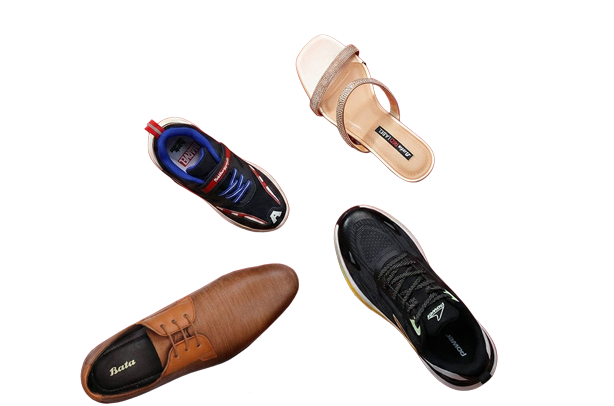
- Youth & casual: Sneakers, athleisure, trendy sandals
- Women’s fashion: Heels, flats, ethnic footwear
- Premium sub-brands: Hush Puppies, Power, Scholl, Weinbrenner
In the last decade, Bata repositioned itself from a “utility brand” to a “fashion-accessible” brand, expanding design cycles and seasonal launches.
 Pricing Strategy
Bata’s pricing philosophy has consistently balanced affordability with perceived value.
- Entry-level pricing to retain mass relevance
- Mid-range pricing for fashion-led collections
- Premium pricing for international sub-brands
Its strength lies in price laddering—allowing a consumer to “grow” within the brand from childhood to adulthood without switching loyalty.
 Promotion Strategy
For decades, Bata relied more on presence than persuasion. Its stores and school shoe dominance were its biggest advertisements.
Key shifts in promotion:
- Transition from product-led ads to lifestyle and fashion communication
- Celebrity endorsements (e.g., Disha Patani, Kriti Sanon at different points)
- Strong seasonal sales messaging (“Power Days”, end-of-season sales)
Recent campaigns have focused on style, comfort, and modernity, consciously shedding the “boring but reliable” tag.
 Distribution Strategy
Bata’s distribution is its most formidable competitive advantage.
- 1,500+ exclusive stores across metros, towns, and small cities
- Strong presence in high streets and neighbourhood markets
- Early mover into company-owned retail (unusual in early India)
- Rapid integration of e-commerce and omni-channel retail
Its deep penetration ensures Bata is often the first footwear store consumers encounter in a new locality.
Challenges and Response
| Challenge | Response |
| Perception as an “old-fashioned” brand | Brand refresh and younger ambassadors |
| Loss of younger consumers to trendier labels | Fashion-led collections and collaborations |
| Margin pressure from discount-led online retail | Strengthening digital channels |
| COVID-19 disruption to physical retail | Rationalisation of store formats and product mix |
Bata’s response strategy has been evolutionary, not disruptive.
Competitive Landscape
Bata has faced evolving competition across eras:
- Unorganised local players (early decades)
- Domestic branded rivals like Relaxo Footwears
- Fashion-first brands like Metro and Mochi
- Global sportswear brands (Nike, Adidas, Puma)
- D2C and online-first brands in recent years
Unlike trend-led competitors, Bata’s moat has been trust + reach + price breadth.
Related Case Studies
Innovations & Adaptation
Key adaptations include:
- Faster design refresh cycles
- Expansion into athleisure and casual wear
- Store modernisation and visual merchandising upgrades
- Integration of online ordering with physical stores
- Data-led inventory and demand planning
Rather than radical innovation, Bata has excelled at incremental modernisation without alienating its core base.
Consumer Perception & Cultural Connect
Bata occupies a unique cultural space in India:
- For decades, school shoes = Bata
- Seen as honest, dependable, and value-driven
- A “safe choice” for parents and professionals
While it may not always be aspirational, Bata is deeply emotionally embedded in Indian middle-class life, spanning generations.
Impact and Legacy
Bata’s legacy includes:
- Creating India’s organised footwear industry
- Normalising factory-made footwear
- Building one of India’s earliest retail chains
- Setting benchmarks for scale, pricing, and accessibility
Few Indian brands can claim 90+ years of continuous relevance across such social and economic change.
Key Learnings
- Distribution can be a stronger moat than branding
- Trust compounds over decades if not broken
- Mass brands can move upmarket—but gradually
- Incremental innovation often outperforms radical reinvention in legacy brands
- Fashion relevance must be renewed continuously, even for heritage brands
Summary
Bata’s journey in India is a masterclass in endurance marketing. It may not always lead trends, but it has survived them all—by understanding Indian consumers deeply, pricing sensibly, distributing relentlessly, and adapting patiently.
In an era obsessed with disruption, Bata proves that consistency, trust, and scale remain powerful competitive weapons.