
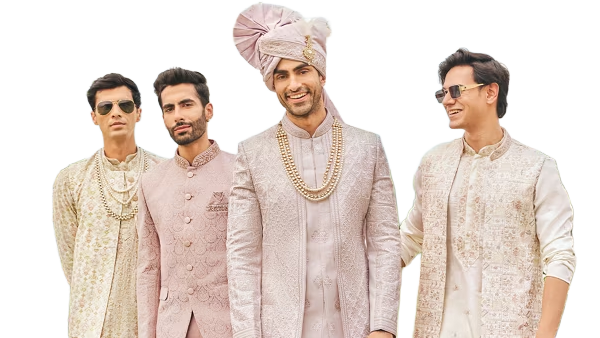


Brand Overview
- Taiyaar Hokar Aaiye
- Pehno Apni Pehchaan
- Rang Jama De
Market Entry & Context
When Manyavar entered the market:
- Men’s ethnic wear was largely unorganised
- Purchases were episodic, local, and dependent on neighbourhood tailors or small boutiques
- Weddings were important, but men’s fashion was secondary to women’s attire
- There was no strong national brand for men’s traditional wear
The late 1990s and early 2000s saw:
- Rising disposable incomes
- Bigger, more performative Indian weddings
- Increased exposure to pan-Indian and Bollywood-led aesthetics
Manyavar entered at the right moment to standardise and scale celebration wear for men.
Marketing Mix (4Ps)
 Product Strategy
Manyavar’s product strategy focused on range, readiness, and relevance:
- Ready-to-wear ethnic clothing for weddings and festivals
- Wide assortment covering groom, family, and guests
- Regional design sensibilities blended into pan-Indian silhouettes
- Consistent refresh aligned with wedding and festive calendars
Over time, the brand expanded into:
- Indo-western wear
- Accessories and footwear
- Occasion-specific collections (weddings, festivals, cultural events)
The key insight: men want assurance and ease, not experimentation, for big occasions.
 Pricing Strategy
Manyavar follows a mass-premium pricing strategy:
- Affordable enough for middle and upper-middle-class consumers
- Premium enough to signal importance and celebration
- Transparent pricing with minimal bargaining
Pricing reinforced the idea that weddings are once-in-a-lifetime moments worth dressing up for, but without couture-level intimidation.
 Promotion Strategy
Promotion has been central to Manyavar’s dominance:
- High-impact advertising with Bollywood stars
- Emphasis on emotion, tradition, and togetherness
- Taglines that celebrate Indian rituals and relationships
- Strong festive and wedding-season bursts
Campaigns avoided fashion elitism, instead focusing on inclusive Indian pride and family celebration.
 Distribution Strategy
Manyavar built one of India’s strongest ethnic retail networks:
- Exclusive brand outlets across metros, Tier 2 and Tier 3 cities
- Franchise-led expansion ensuring rapid scale
- Prime high-street and mall locations
- Consistent store design and service standards
Distribution ensured that Manyavar was visible wherever weddings were happening, not just in fashion capitals.
Challenges and Response
| Challenge | Response |
| Fragmented regional tastes | Broad, adaptable design language |
| Fashion cyclicality | Occasion-led positioning over trends |
| Competition from designers | Focus on accessibility and scale |
| Dependence on wedding seasons | Expansion into festivals and everyday ethnic |
| Maintaining freshness | New collections and celebrity associations |
Manyavar chose consistency over constant reinvention.
Competitive Landscape
Manyavar competes with:
- Regional ethnic wear brands
- Local tailors and boutiques
- Designer labels at the premium end
- Emerging organised players (e.g., Raymond Ethnix, Fabindia Men)
Manyavar’s differentiation:
- National scale
- Occasion ownership (weddings)
- High recall advertising
- Trust and convenience
It effectively category-owned men’s celebration wear.
Related Case Studies
Innovations & Adaptation
Manyavar’s innovations were largely format and mindset driven:
- Standardising sizing and fit in ethnic wear
- Making ready-to-wear acceptable for weddings
- Blending regional styles into a national offering
- Expanding into women’s wear via Mohey to capture the full wedding ecosystem
The brand innovated by simplifying a complex, emotional purchase.
Consumer Perception & Cultural Connect
Manyavar is perceived as:
- The default choice for men’s wedding wear
- Trustworthy, celebratory, and respectful of tradition
- Stylish without being intimidating
Culturally, Manyavar:
- Put men back at the centre of wedding fashion
- Normalised dressing well as part of Indian masculinity
- Became part of family wedding rituals across generations
For many families, a wedding shopping trip begins at Manyavar.
Impact and Legacy
Manyavar’s impact includes:
- Creating India’s first national men’s ethnic wear brand
- Organising a fragmented, tailor-led category
- Elevating men’s role in wedding aesthetics
- Inspiring similar category-led ethnic brands
It turned men’s ethnic wear into a scalable, branded retail business.
Key Learnings
- Categories can be created by owning occasions
- Cultural insight can outperform fashion innovation
- Distribution depth builds default choice status
- Mass-premium positioning suits Indian celebrations
- Consistency builds long-term leadership
Summary
Manyavar’s journey is a textbook case of category creation through cultural ownership. By understanding the emotional importance of weddings and simplifying ethnic wear for men, the brand transformed an unorganised, intimidating market into a trusted, national retail category. Its success shows that in India, brands that respect tradition while delivering convenience at scale can build enduring leadership.