
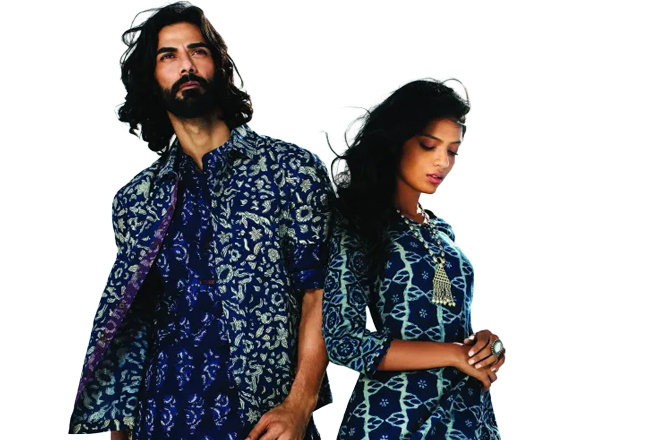


Brand Overview
- Celebrate India
- Serving India
Market Entry and Context
Fabindia’s entry must be seen in two phases:
Phase 1: Export-first (1960s–1980s)
- India had little organised lifestyle retail
- Craft products were largely unbranded and export-oriented
- Urban Indian consumers associated “modern” with Western products
Phase 2: Domestic retail expansion (1990s onward)
- Economic liberalisation created a new urban middle class
- Growing pride in Indian identity and heritage
- Rising demand for differentiated, meaningful consumption
Fabindia entered the domestic retail market when “Indian” was becoming aspirational again, not regressive.
Marketing Mix (4Ps)
 Product Strategy
Fabindia’s product strategy is rooted in craft-led diversification:
- Core apparel: ethnic wear using handwoven and natural fabrics
- Home furnishings: rugs, cushions, furniture
- Personal care and food products emphasising natural ingredients
- Seasonal and festive collections aligned with Indian calendars
Key principles:
- Artisan-based sourcing
- Natural fibres and dyes
- Functional modern silhouettes with traditional techniques
Products were positioned as everyday usable, not museum craft, making heritage relevant to modern life.
 Pricing Strategy
Fabindia followed a value-premium pricing strategy:
- Priced above mass-market ethnic wear
- Below luxury or designer labels
- Premium justified by craftsmanship, materials, and ethics
The brand avoided discount-led positioning, reinforcing the idea that handcrafted equals valuable, not cheap.
 Promotion Strategy
Fabindia’s promotion has been understated and values-driven:
- Minimal mass advertising
- Strong in-store storytelling
- Word-of-mouth and loyal customer base
- Subtle print and digital communication focused on craft, not celebrity
The brand relied on philosophy over persuasion, trusting its audience to discover and adopt it.
 Distribution Strategy
Fabindia built a distinctive retail footprint:
- Large-format exclusive brand stores
- High-street locations in metros and Tier 1 cities
- Calm, earthy store aesthetics reinforcing brand values
- Gradual omnichannel presence through e-commerce
Retail spaces were designed as cultural sanctuaries, not high-pressure sales environments.
Challenges and Response
| Challenge | Response |
| Perception of being “old-fashioned” | Product refresh and modern cuts |
| Younger consumer disconnect | Youth-focused lines and branding attempts |
| Scaling artisan supply sustainably | Cluster-based sourcing and training |
| Competition from fast fashion | Reinforced slow fashion narrative |
| IPO-related scrutiny | Strategic refocus on core brand strengths |
Fabindia often struggled between scale and soul, a classic tension for mission-led brands.
Competitive Landscape
Fabindia competes in a fragmented landscape:
- Ethnic wear brands (Biba, W)
- Designer-led labels
- Local boutiques and craft stores
- Global fast-fashion brands (indirect competition)
Fabindia’s differentiation lies in:
- Authentic craft linkage
- End-to-end supply chain involvement
- Strong ideological positioning
Few competitors matched its depth of provenance.
Related Case Studies
Innovations & Adaptation
Fabindia innovated structurally more than technologically:
- One of India’s earliest social enterprise models
- Equity participation for artisan suppliers
- Pioneering “craft as lifestyle” retailing
- Expansion into organic foods and wellness ahead of the curve
Later adaptations included:
- E-commerce and digital catalogues
- Younger sub-brands and modern silhouettes
- Experimentation with cafés and experiential formats
Consumer Perception & Cultural Connect
Fabindia is perceived as:
- Authentic, ethical, and trustworthy
- Intellectually and culturally premium
- A brand for conscious, educated consumers
Culturally, it:
- Normalised pride in Indian textiles and crafts
- Became a uniform for urban India’s liberal intelligentsia
- Linked consumption with values long before “sustainability” became mainstream
Fabindia was not just worn—it was believed in.
Impact and Legacy
Fabindia’s legacy is deep and enduring:
- Created a national market for handcrafted products
- Proved artisans could be part of organised retail value chains
- Influenced dozens of craft, organic, and ethical brands
- Helped reframe “Made in India” as desirable and modern
It is one of India’s earliest and most credible purpose-driven consumer brands.
Key Learnings
- Purpose can be a powerful differentiator
- Cultural authenticity creates long-term loyalty
- Retail design can reinforce brand philosophy
- Scaling values-driven businesses requires patience
- Brands can shape taste, not just follow it
Summary
Fabindia’s journey is a rare example of a brand that built commerce around culture rather than extracting from it. By placing Indian craftsmanship at the centre of modern retail, Fabindia created a brand that transcended fashion cycles and market trends. Its story illustrates both the power and the complexity of building a values-led brand at scale—where success is measured not just in revenue, but in cultural impact.